
Finance and accountancy professionals don’t operate in a vacuum. Their work is fast-paced, analytical, and deeply rooted in real-world problem-solving—whether that’s balancing financial statements, making data-driven investment decisions, or ensuring compliance with ever-changing regulations. Despite this, many financial exams still rely on outdated assessment methods that focus on theory rather than practical skills.
An accountant isn’t proving their expertise by picking the correct definition of “accrued revenue” from a multiple-choice list. An investment analyst isn’t demonstrating job readiness by recalling financial ratios from memory. A tax consultant doesn’t apply compliance knowledge by writing a short paragraph about tax laws. In reality, finance professionals work with live data, complex models, and tight deadlines—yet, most exams fail to test these skills in a meaningful way.
As a result:
- Employers struggle to trust that a passing grade means job readiness.
- Candidates lack opportunities to showcase their ability to apply financial knowledge in context.
- Awarding organisations risk falling behind in providing assessments that meet industry needs.
To bridge this gap, finance and accountancy exams need a rethink. A shift towards more applied assessment methods—incorporating specialised financial question types, Microsoft Office 365 integration, and structured exam sections—ensures that candidates aren’t just tested on what they know, but on how they use that knowledge in practice.
Beyond multiple choice: financial statement question types
Most finance exams still rely on static question types, such as:
- Multiple-choice questions that test recall but not financial application.
- Fill-in-the-blank calculations that assess isolated knowledge rather than full financial processes.
- Short-answer responses that lack interaction with actual financial data.
While these formats may be useful for foundational knowledge, they fail to test whether a candidate can handle real-world financial tasks.
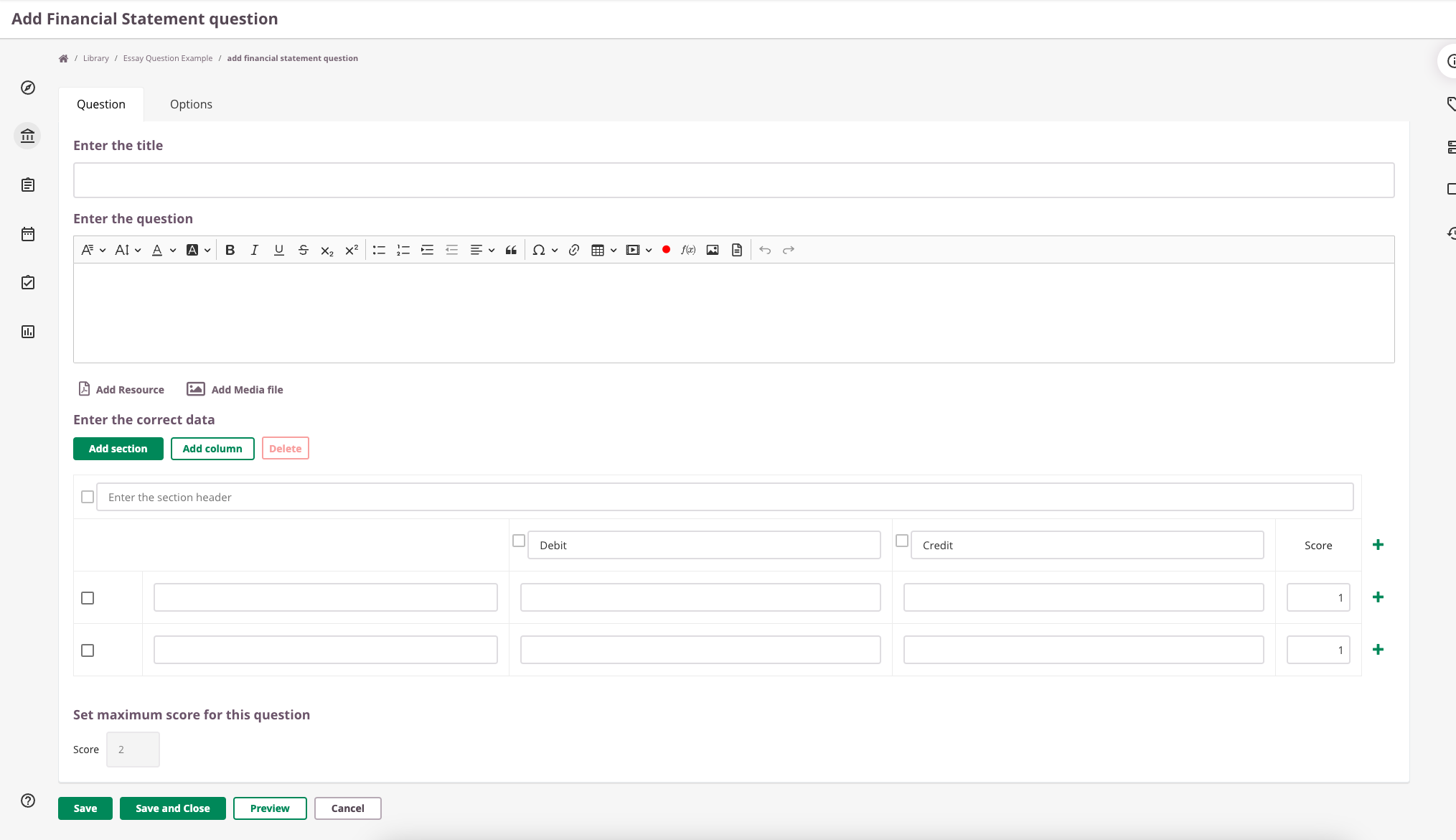
The Financial Statement Question Type allows candidates to interact with financial records, categorise transactions, and balance financial statements within the exam environment.
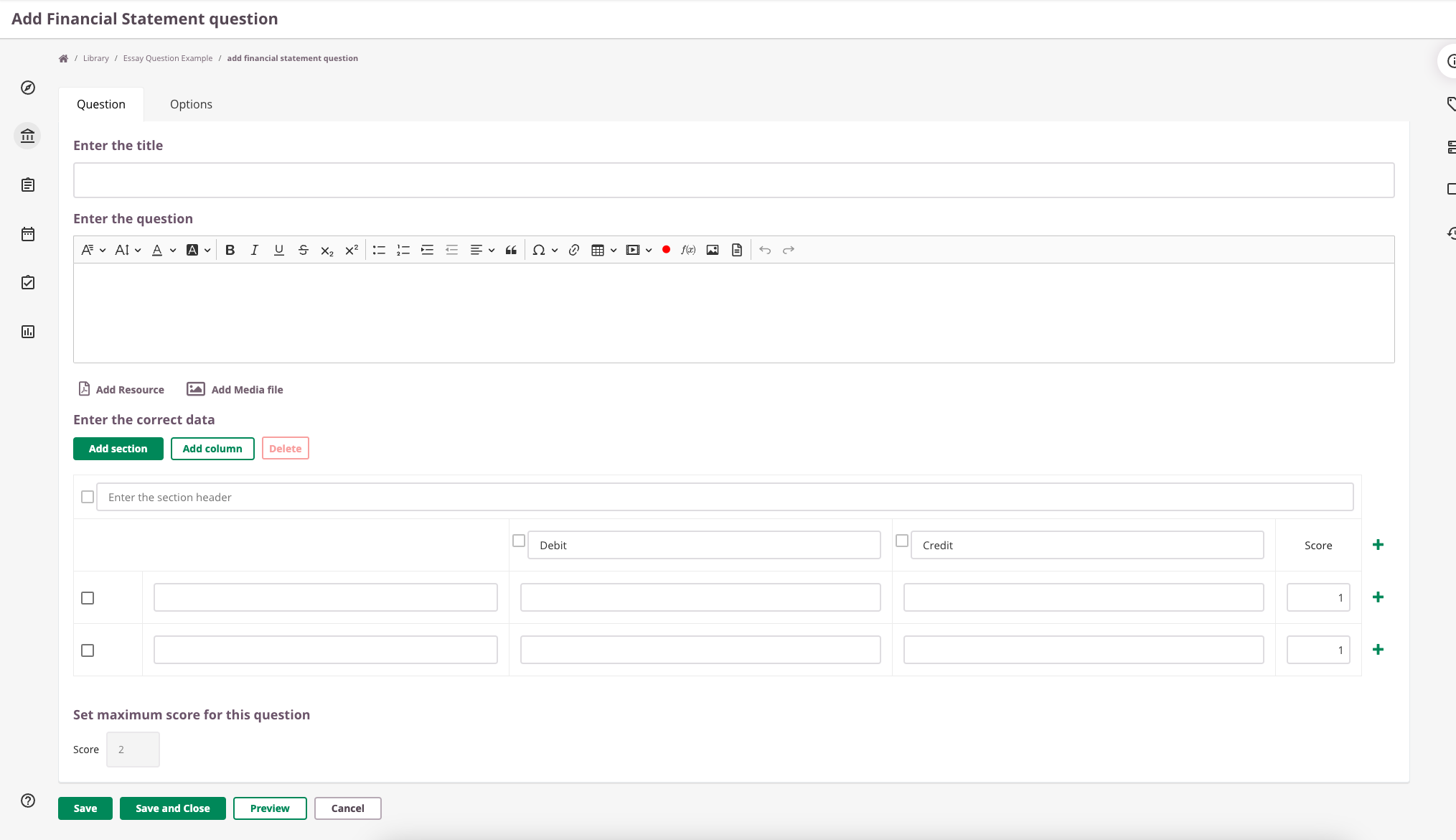
For example, in an accountancy certification exam, candidates might be presented with:
Scenario:
You are the financial accountant at Brew & Bean Ltd., an independent coffee roastery. With the company expanding into wholesale, transactions are increasing, and the finance team needs your help to keep the books accurate.
As part of the month-end close, you’ve been given a list of transactions, but some entries need classifying to ensure the trial balance is correct.
Candidate tasks:
- Sort transactions into debit and credit entries based on standard accounting principles.
- Classify financial items under assets, liabilities, revenue, or expenses.
- Ensure the trial balance remains accurate.
Example Transactions:
- A wholesale customer pays an outstanding invoice (£2,500).
- Brew & Bean purchases new espresso machines (£5,000).
- The company receives a business loan (£10,000).
- An order of coffee beans is purchased from a supplier (£3,200).
- The company pays staff salaries (£6,500).
- Brew & Bean earns revenue from direct coffee sales (£4,800).
- A customer requests a refund for a faulty coffee grinder (£250).
What This Question Tests:
- Understanding of debits and credits in a real business setting.
- Attention to detail in financial classification.
- Ability to ensure a balanced trial statement without errors.
This practical scenario mirrors real-world accounting tasks, ensuring candidates demonstrate applied skills rather than just recalling theory.
Microsoft Office 365 integration: the key to real-world finance exams
In the finance industry, Excel isn’t just a tool—it’s a necessity. From financial modelling and revenue forecasting to balance sheet reconciliation and risk analysis, finance professionals rely on spreadsheets for almost every aspect of their work.
Yet, many exam platforms don’t offer the functionality to use Excel, leaving candidates stuck with rigid text fields or static multiple-choice questions. This creates a disconnect between assessment and real-world competency—a candidate might score highly by recalling formulas, but if they can’t apply them within a live financial model, they’ll struggle in a professional setting.
Bringing financial exams closer to reality
With Office 365 integration, financial exams become a test of applied skill. Instead of selecting pre-set answers, candidates can:
- Work in real Excel spreadsheets within the exam environment.
- Build and manipulate financial models, just as they would in their day-to-day role.
- Use advanced formulas, pivot tables, and data visualisation tools to analyse financial statements.
Cirrus Top Tips for using Office 365
💡 Simulate real business cases. Use authentic datasets, profit and loss statements, and historical market trends to test real analytical ability.
💡 Use automated grading where possible. Evaluate candidates based on correct formula usage, logical structuring of financial data, and accuracy of results.
💡 Ensure the exam environment is secure. Candidates should work within a locked-down Excel environment that prevents external access but retains full Excel functionality.
Structuring Exams Like Real Financial Workflows
Not all financial tasks are created equal. In real-world finance, some tasks require deep analysis, while others demand quick decision-making under pressure.
For example:
- Preparing a financial statement may take hours, requiring careful review and accuracy.
- An auditor responding to discrepancies may have only minutes to make a correction.
- A risk manager making investment decisions must act quickly under pressure.
By structuring exams into distinct sections, awarding organisations can create a more natural and realistic assessment experience—one that reflects how financial professionals actually work.
Example: Using varied time ‘Sections’ to simulate an authentic feel
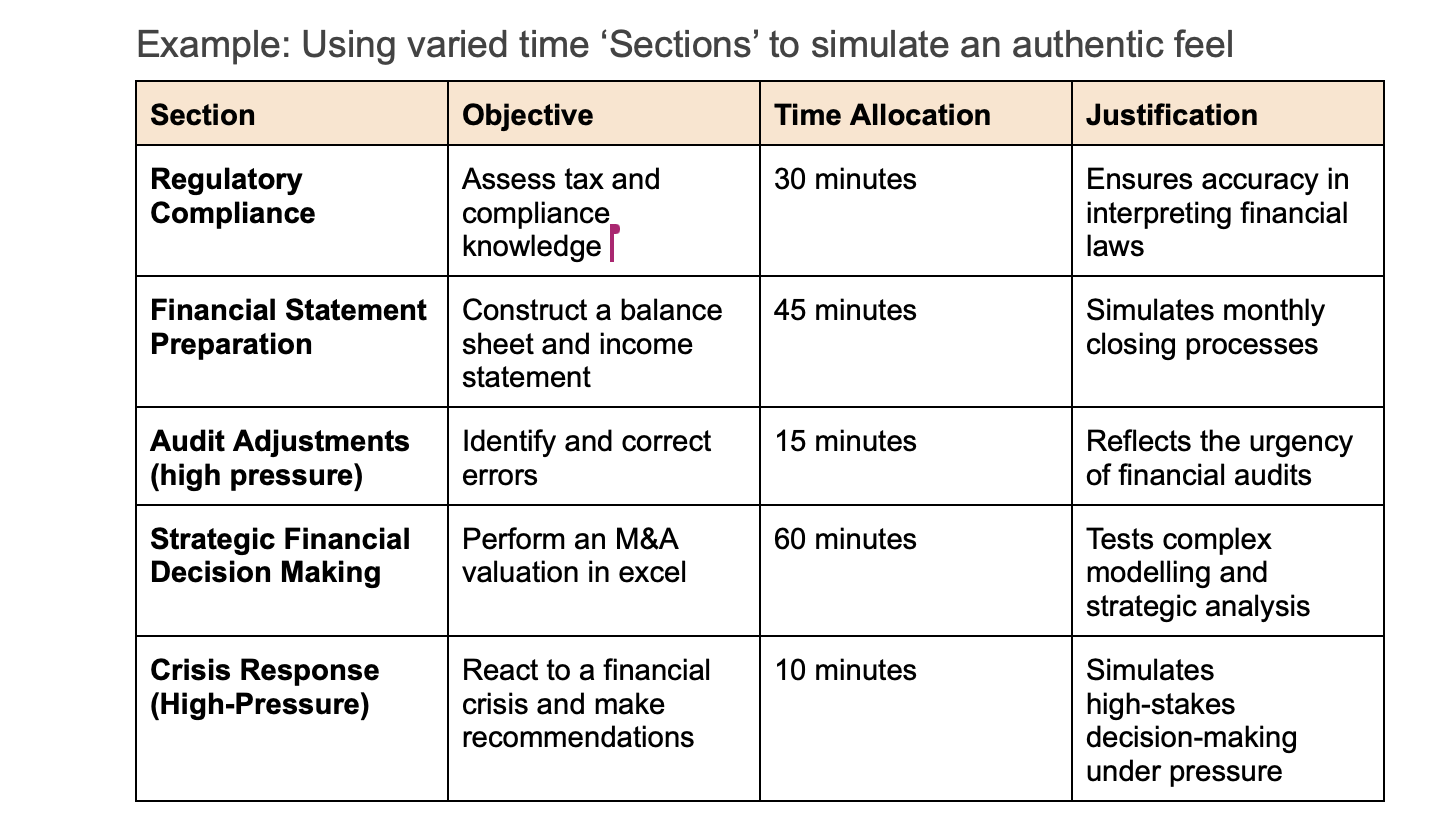
Why time pressure matters
- Mirrors real-world decision-making. CFOs, financial analysts, and risk managers often have minutes—not hours—to react to market changes, regulatory updates, or financial crises.
- Tests the ability to prioritise. In time-sensitive situations, finance professionals must quickly distinguish critical financial risks from minor setbacks.
- Prepares candidates for leadership roles. Financial leaders are expected to make rapid, well-reasoned decisions, often with incomplete data.
A truly effective finance exam goes beyond testing knowledge—it measures how well candidates can think, analyse, and act in real-world scenarios. By structuring exams with authentic financial tasks, dynamic question types, and time-based challenges, awarding organisations can ensure their assessments reflect the pressures and complexities of modern finance.
Ready to future-proof your finance exams?
Security, efficiency, and authenticity don’t have to be trade-offs. From preventing cheating to making assessments more relevant to real-world finance, e-assessment is evolving.
Subscribe to Finance Exam Insider for best practices, industry events, and the latest research to help you stay informed and improve your exams.