
How to keep your exam content unpredictable
Cheating happens. Whether it’s sharing questions after the fact or trying to exploit the loopholes in your exam, there’s always going to be someone who pushes the boundaries. That’s why Cirrus gives you the tools to outsmart even the sneakiest of test-takers.
This edition of Hidden Gems is all about randomisation – how to mix things up so that every candidate sees a unique version of your exam. When done right, it not only protects your content, but also helps preserve the fairness and integrity of your assessments.
Let’s start with the simplest place:
Start small: Randomise alternative order (and the correct answer too)
Even within a single item, you can keep candidates on their toes. In Cirrus, you have the option to shuffle the order of alternative answers—meaning answer A for one person might appear as answer C for another.

You can even randomise the position of the correct answer each time the question appears.
This simple setting makes it harder for candidates to memorise answer positions or share quick answers like “it’s option B.” Instead, they have to engage with the content—every time.
Display questions in random order
Sometimes the best tricks are the easiest ones. With just a single setting in Cirrus, you can shuffle the order of questions so that every candidate sees the same questions, just in a different sequence.
This subtle change makes it harder for candidates to copy off their neighbour or pass on the exact sequence to someone else. And it takes zero extra effort to set up.
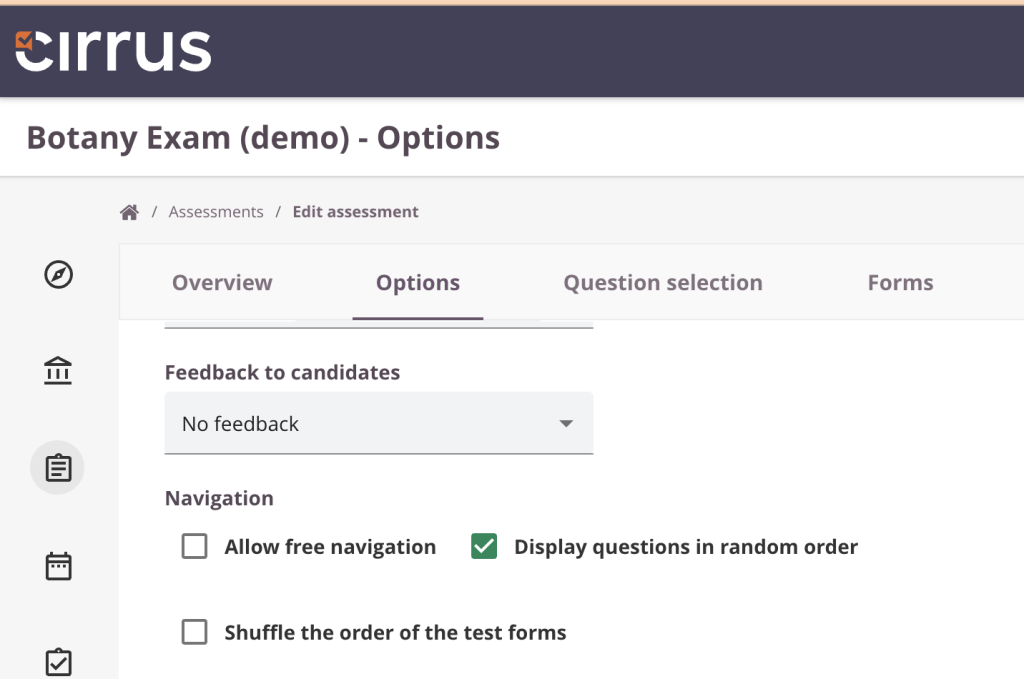
💡 Heads up: This applies to the order of questions within a section, not to the individual sub-questions within a question or across sections.
Shuffle the order of test forms
Sometimes randomising question order isn’t quite enough. If you want to take it further, you can create multiple forms of the same assessment in Cirrus.
Each form is a different version of the exam—with its own set of questions, layout, and scoring setup. Cirrus can then randomly assign a form to each candidate when they start the exam.
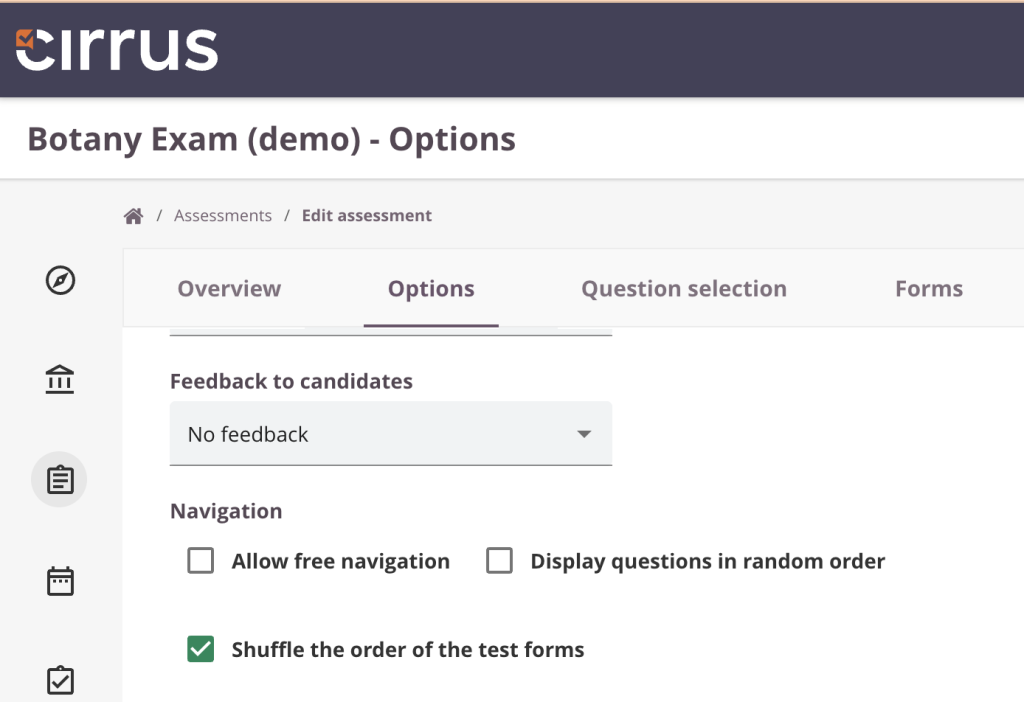
So while it’s technically the “same” assessment, different candidates might get different questions. Thanks to shared scoring scales, results stay consistent and easy to compare.
When does it make sense to use multiple forms?
- When you want some randomness, but still need to validate forms with psychometric data
- When you want a separate version for resit candidates, without extra admin
- When you’re running high-stakes exams and want to reduce the chance of content being passed around
Once the forms are set up, Cirrus handles the rest—random assignment happens automatically. No extra work for you.
Linear-on-the-fly testing (LOFT) with the Cirrus Blueprint
Now we’re getting clever. Linear-on-the-fly testing (LOFT) lets you create a pool of questions grouped by topic, difficulty, or learning objectives you choose, and Cirrus will build a unique version of the exam for each candidate in real time.
This is all made possible through the Blueprint in Cirrus, where you define exactly how many questions to draw from each category. The platform then pulls from the item bank at the moment the candidate starts their exam, ensuring no two tests are the same.
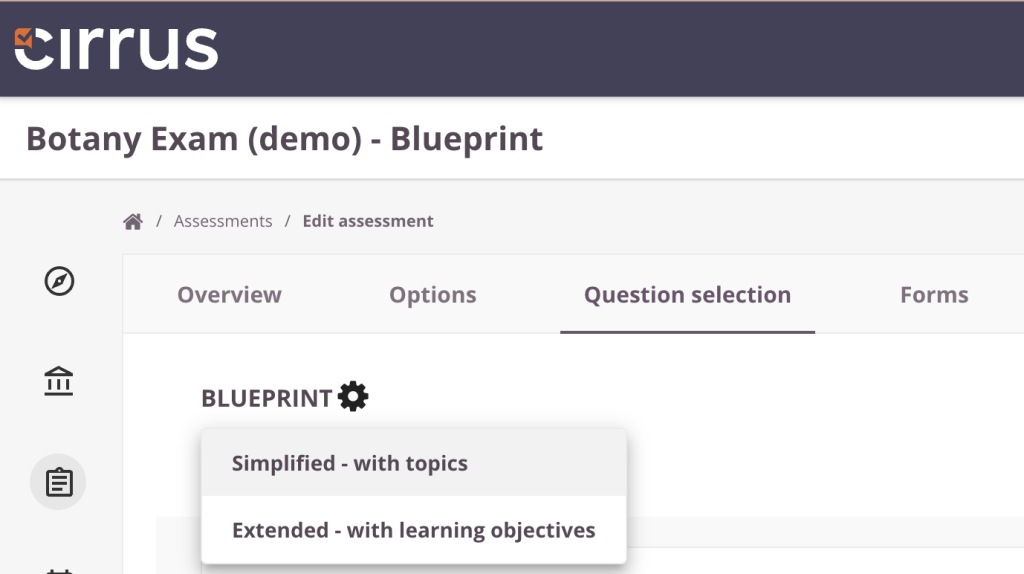
Example: You might tell Cirrus to build a 50-question exam using 10 questions from each of five topics, with a mix of 30% easy, 35% medium, and 25% hard. Each candidate gets different questions, but the structure and balance stay the same.
Why use LOFT?
- It dramatically reduces the chances of question-sharing
- It keeps your assessments balanced, fair, and aligned to learning objectives
- It scales, even for large cohorts
And because it’s all drawn from your validated item bank, the quality and integrity of the questions remain intact.
Parameterisation: One question, many variations
Sometimes one question just isn’t enough—but writing the same thing over and over with slight tweaks? No thanks.
With parameterisation in Cirrus, you can create questions that automatically swap out key details like names, numbers, or scenarios every time they’re shown. The structure stays the same, but the specifics change.
For example: A maths question might ask for the area of a triangle. Each student sees different base and height values, but it’s still testing the same skill.
Why use parameterisation?
- You can get multiple versions out of one question.
- It’s a quick way to grow your item bank without duplicating work.
- It adds another layer of unpredictability that helps prevent sharing or memorisation.
Used alongside question shuffling, LOFT, or multiple forms, parameterisation helps make sure no two tests feel quite the same while keeping everything consistent and fair.
Final Thoughts: Keep them guessing
Randomisation isn’t about confusing candidates. It’s about keeping your exams fair, secure, and less open to shortcuts. With features like question shuffling, multiple forms, LOFT, and parameterisation, Cirrus helps you mix things up, without losing control.